
Government figures released in June 2026 show illegal tobacco cost the UK £1.7BN in lost tax revenue just last year. And the hidden costs are even higher.
0:00 / 0:00
The latest tax gaps data released by HMRC in June 2026 paint a concerning picture. Illegal tobacco cost the UK £1.7BN in 2024/2025.[1]
Rogue traders and serious organised criminals are profiting from selling illegal tobacco on British high streets, using the proceeds to fund more sinister crimes such as weapons and drug smuggling and even human trafficking.[2]
Honest retailers are being forced to shut down as they can no longer compete with the criminals’ pricing [3]. JTI’s cheapest cigarette brand on the market costs around £13.60 [4], most of which is tax paid to HMRC, whereas a pack of illegal cigarettes costs as little as £5 [5].
Communities are feeling the burden, with money that could be invested into regenerating high streets and local areas diverted to organised crime instead.
75% of those surveyed nationally find increased crime and violence associated with illegal tobacco in local communities very concerning. This is up from 63% in 2025.[6]
That cheap pack of cigarettes, it costs more than you think.
The Government recently announced £30m of funding for a new High Street Organised Crime Unit[7]. The new funding aims to boost police and Trading Standards’ response to organised crime. This sits alongside a further commitment to recruit 500 new officers to tackle organised crime as part of a £550 million crackdown in the 2026-29 Anti Money Laundering and Asset Recovery Strategy announced in September 2026.[8]
Home Secretary Shabana Mahmood has also announced proposals to toughen enforcement by doubling the maximum closure period for illicit retailers, as part of efforts to tackle organised crime on British high streets [8].
Under current rules in England and Wales, premises can be closed for three months, with an option to extend the closure to six months [9]. The government’s proposals, expected to become law by the end of 2026 after consultation, would double the maximum closure period to 12 months.
Legitimate businesses cannot really compete because they are paying wages and taxes that these businesses are not paying.
Dennis Chalmers
Lead Officer for Serious Organised Crime at the Chartered Trading Standards Institute
Q38, Home Affairs Select Committee Session 16 June 2026 - Oral evidence: The impact of serious and organised crime on local neighbourhoods, HC 36. Full transcript available here.
2027 WILL BRING A NEW TEST FOR ENFORCEMENT
From 1 January 2027, new age-of-sale restrictions will change how legal tobacco is sold in the UK. With legitimate retailers adapting to new rules, getting the enforcement framework right – including effective licensing and properly resourced enforcement – will become even more important.
JTI IS CALLING ON THE GOVERNMENT TO TREAT ILLEGAL TOBACCO AS A SERIOUS ECONOMIC AND SOCIAL ISSUE.
WHAT NEEDS TO CHANGE:
1.
National licensing scheme
National licensing scheme
- We are calling for a national, whole supply chain licensing scheme covering all tobacco and nicotine products to be introduced as a matter of urgency. A single national regime would provide consistent standards across the UK, support legitimate retailers and make it more difficult for organised crime groups to exploit gaps between local enforcement regimes.
- The proposed retailer licensing scheme for tobacco and nicotine should be extended to the whole supply chain, as is the case for alcohol.
2.
Credible enforcement
Credible enforcement
- A licensing scheme must be backed by robust enforcement powers if it is to deliver its objectives. Licensing and enforcement are two sides of the same coin; one will not succeed without the other.
- Penalties of up to £10,000 should apply to businesses selling illicit tobacco or nicotine products (as is the case for alcohol). Meaningful sanctions are essential to create a credible deterrent and make it significantly harder for criminals to operate openly on UK high streets.
- Closure Notices should be used more consistently. Whilst the reported extension of maximum closure periods to 12 months is welcome, consideration should be given to greater alignment across the UK, where stronger banning orders of up to 24 months are already available in Scotland. In addition, penalties of up to £10,000 (depending on level of repeat offence) be attached to Closure Notices, requiring payment before the premises are allowed to reopen.
- Where the same premises are repeatedly linked to illicit tobacco and nicotine sales under different operators, enforcement action should be capable of extending beyond the individual licence holder. Local authorities should have powers to act against leaseholders or landlords where there is evidence that they have knowingly enabled persistent illegal activity.
- Retailers found repeatedly selling illicit tobacco and nicotine products should be subject to licence suspension or revocation. Persistent offenders should not be allowed to continue operating within the legitimate market alongside honest retailers.
- All enforcement agencies should be able to make full use of existing powers under the Proceeds of Crime Act. In addition to the seizure of illicit stock, authorities should consider confiscating criminal profits, vehicles, storage facilities, equipment and associated cash used to facilitate the illegal trade.
3.
Sustainable funding
Sustainable funding
- Revenues generated from licensing penalties and confiscated proceeds should be ringfenced to reinvest into Trading Standards and other local enforcement agencies.
- This would provide a sustainable, self-funding mechanism for enforcement activity, ensuring that those who profit from illegal trade contribute directly to the resources needed to tackle it.
- Funding enforcement in this way would help ensure that a licensing scheme delivers meaningful outcomes, protecting communities, supporting legitimate retailers and disrupting organised criminal networks.
4.
Introduce a single, credible methodology for determining the size of illicit tobacco market
Introduce a single, credible methodology for determining the size of illicit tobacco market
- It is not possible to fix a problem that you cannot reliably measure. Currently, nobody can agree how big the black market for illegal tobacco is. A single, credible methodology is required to ensure that the right policy decisions are being taken on enforcement and excise tax.
Impact on communities
Illegal tobacco can affect communities in multiple ways.
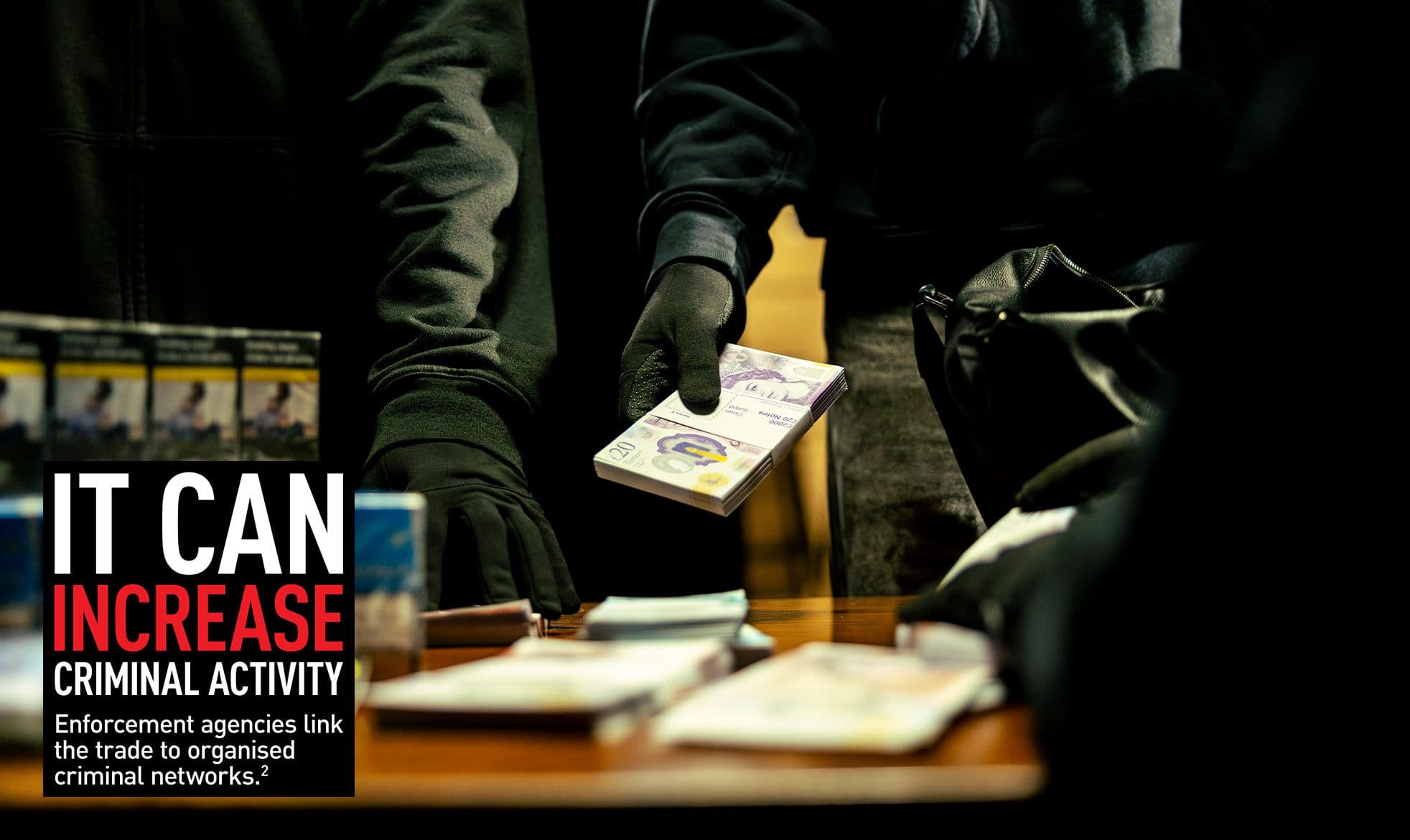
-It can increase criminal activity
Enforcement agencies link the trade to organised criminal networks.2
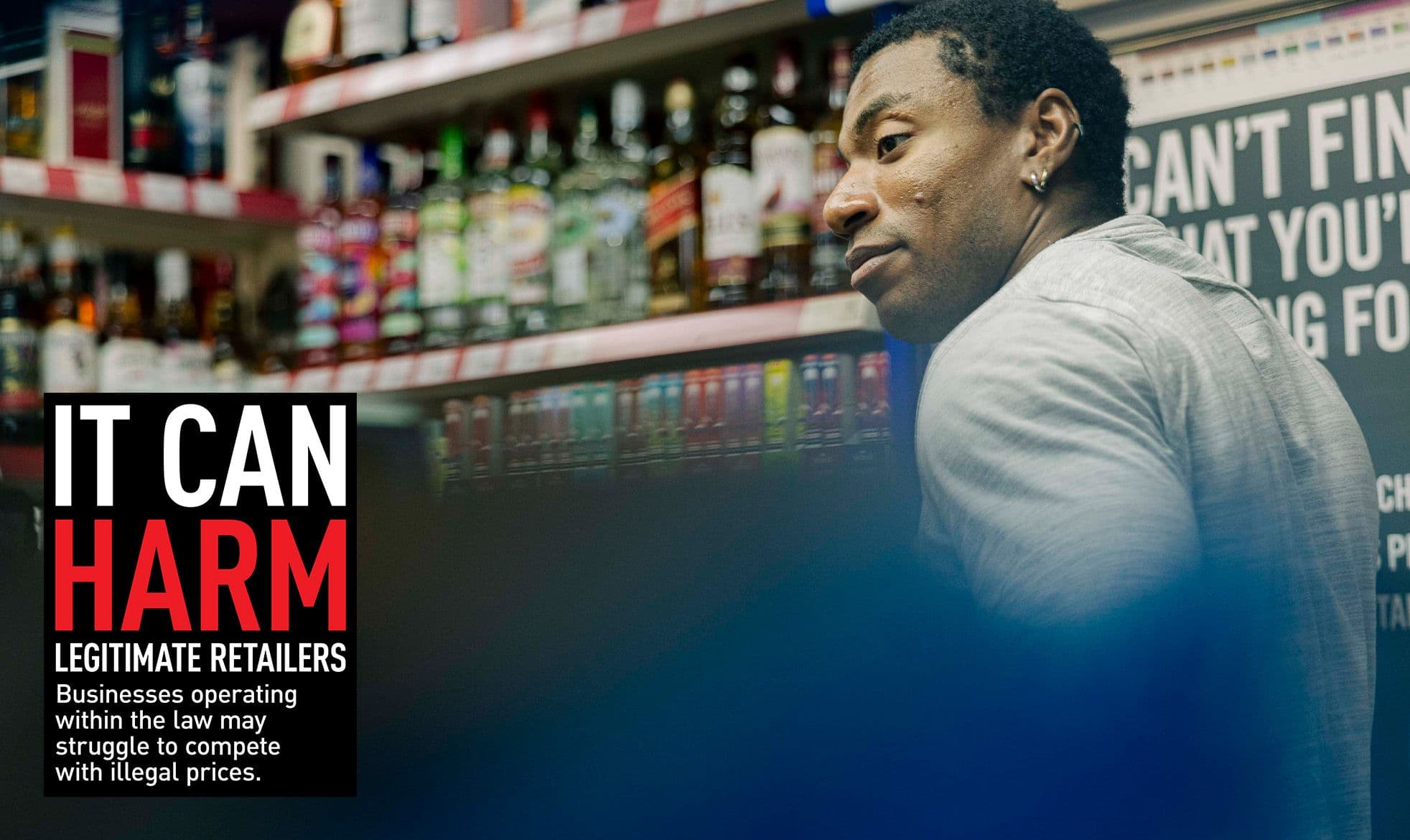
It can harm legitimate retailers
Businesses operating within the law may struggle to compete with illegal prices.
It can weaken local economies
Money spent on illegal goods damages the legal economy.
Rising costs are damaging our business as well as the reduced profits from illegal tobacco sales [elsewhere]. The sales that we [would] normally get from add-ons reduces our profits massively. We have to consider how many staff we can afford to pay now and really we want to be paying them a higher wage than we do. We need the government to tackle this problem head on and deal with it.”
Retailer, Liverpool
Click here to find out more about the impact illegal tobacco has on communities including how you can spot it, anonymously report it and help shut it down.
IT'S TIME TO SHUT IT DOWN.
Seen something suspicious?
You don't need to confront anyone.
You can report it anonymously, quickly and safely.
If you're aware of anybody selling illegal tobacco you should report this using the anonymous form above, or by contacting HM Revenue & Customs' Fraud Hotline on 0800 788 887, Trading Standards (through the Citizens Advice consumer helpline) on 0808 223 1133 or Crimestoppers on 0800 555 111.
Want to help put a stop to the illegal tobacco trade?
Access our email letter to urge your MP to take action against illegal tobacco harming businesses and communities. Find out who to contact here.
We can all play a part in helping to stop the illegal tobacco trade and the negative impact it has on communities.
[1] £1.7bn figure based on HMRC's tax gap estimates for Excise Duty and VAT losses 2024 - 2025. Measuring_tax_gap_online_tables_2026.xlsx (select the table for 2026 and go to table 3.4 See lines 8 and 9 combined for 2024-2025).
[2] HM Revenue & Customs & Border Force. (2024, January 29). Stubbing out the problem: A new strategy to tackle illicit tobacco. GOV.UK. Updated March 1, 2024.
[3] Hidden-in-plain-sight-tackling-crime-on-the-uks-high-streets.pdf
[4] Recommended retail price correct as at 15 June 2026. Retailers are free to price as they choose.
[5] Test purchasing was conducted by a trained undercover operative commissioned by JTI UK.
[6] This data is based on an online survey that was conducted for JTI by an independent British Polling Council accredited research agency between January 7 and January 29 2026, involving a sample of 15,228 UK adults aged 19 and over. To ensure the findings are representative of the UK general population, the data was weighted by age, gender and region.
[7] New high street unit set up in nationwide blitz on dodgy shops - GOV.UK
[8] Hundreds of new officers to hunt down dirty money networks - GOV.UK
[9] New laws to shutdown dodgy high street shops in crime crackdown - GOV.UK
[10] https://www.legislation.gov.uk/ukpga/2014/12/part/4/chapter/3